


For daily news, updates, and analysis, be sure to follow us on Instagram. If you are able to support independent journalism, please make a tax-deductible donation to News Not Noise here.
When I was a kid, my community service project was volunteering at what was then called the Rape Treatment Center in Santa Monica, California.
I remember sitting in the office helping file cases. Files about women who said they’d been raped by police officers after being pulled over. Files about women who reported being raped after a night out, then found themselves answering questions about how much they’d had to drink or what they’d been wearing. And a lot of files involving college students.
This was the late ‘80s. Even then, I could see a pattern. The cases involving athletes and fraternities seemed to activate an entire system: coaches, administrators, alumni, lawyers. Suddenly, the question wasn’t only what happened to her. It was what an accusation might do to his future.
Of course rape allegations can be complicated. An accusation is not proof. The accused deserves due process. Getting it wrong can alter the course of someone’s life.
What bothered me then was how exquisitely attuned institutions seemed to the life-altering consequences for one of those people. What would this do to his future? His education? His career? His reputation?
Those are legitimate questions. But being raped can alter the course of a life, too. So can reporting it and not being believed. Or watching an institution close ranks around everyone but you.
It’s been decades since I filed those cases. (Man, that’s hard to write.)
After forty years of shifting attitudes, laws, and rules, I thought something important really did change. Especially on university campuses. Not that women should automatically be believed or men presumed guilty. That institutions had learned to take an allegation seriously, investigate it fairly, and weigh the consequences for both people.
Then came the story of the Cornell 7, which we write about below.
Reading it brought back something I hadn’t thought about in years: those files.
A lot has changed since the 1980s. The language changed. The rules changed. Some instincts changed.
But maybe we’ve been a little too confident about how much the power structures changed with them. In some places, the old machinery is still there. And sometimes it takes a story like this to remind us.
In today’s newsletter: A Cornell gang rape case, reopened. This is bigger than one campus. Trump narrows LGBTQ college protections. Automakers, start your guessing. CNN gets left out. And in News That Doesn’t Suck… your dog heard that!
Here Are Your Headlines
College Nightmare: [Trigger warning: Discussion of sexual assault, graphic language] A New York district attorney reopened an investigation into the alleged gang rape of a woman at a Cornell fraternity house after she filed a lawsuit against the seven men she accuses of participating in the rape, the university, and others. According to the lawsuit, the woman, a former Cornell student referred to anonymously as Jane Doe, went to the house of the Chi Phi fraternity in October 2024. There, she alleges multiple fraternity members “drugged and raped” her. The lawsuit claims that one of the defendants sent a message to a fraternity Snapchat group chat advertising “free pussy,” encouraging other fraternity members “to join in on the gang rape.” “There were so many people that could have prevented it,” Jane Doe’s attorney said, “and they didn’t. I’ve never seen anything like it.” A few weeks later, Jane Doe reported the incident to Cornell police, and the university launched a Title IX investigation. The university banned its chapter of Chi Phi and launched a task force on sexual assaults, which published a formal report and made recommendations earlier this year. Two of the seven accused frat members were expelled. The other five were made to serve brief suspensions and attend workshops. Some were assigned essays (yes you read that right). None faced criminal charges, Jane Doe’s lawyer said. Today, after the civil suit made national headlines and went viral, the district attorney said he had been unable to bring charges because Jane Doe’s original police statement “described her drug use and sexual conduct as voluntary, conscious, and consensual.” He said his office is now preparing to present a case to a grand jury. Jane Doe’s lawyer insisted her allegations to police and in the lawsuit were “not materially different,” and faulted the district attorney’s office for not conducting an independent investigation.
Not New: Sexual assault is widespread on college campuses. Cornell’s 2025 survey found that 35% of undergraduate women experienced “nonconsensual sexual contact,” up from 23% in 2023. Cornell cautions the 2025 survey had a significantly lower response rate. Nationwide, roughly one in every four undergraduate women and one in 14 undergraduate men experience rape or sexual assault at college. Experts believe these figures are massive undercounts, as many incidents go unreported.
What’s Fair: The rules governing how colleges handle sexual misconduct are shifting again, thanks to Trump. The Education Department just formally scrapped Biden-era rules on campus sexual harassment and assault and announced it is returning to rules from Trump’s first term. Those rules reversed stricter Obama-era policies that Trump officials claimed were unfair to the accused, reportedly following pressure from men’s rights organizations claiming an epidemic of false rape allegations. The Trump-era rules narrow the kinds of incidents that must be investigated, allow students who file reports to be cross examined, and permit universities to require higher standards of evidence to determine responsibility. When these changes were first proposed, dozens of organizations and experts protested, with one warning they would “tip the balance … heavily in favor of alleged perpetrators.”
Minority Targets: The Trump administration’s repeal of Biden’s Title IX protections also weakens federal protections for LGBTQ students, as well as students who are pregnant or parenting. The Biden-era rule strengthened Title IX protections based on gender identity and sexual orientation. In 2025, a federal judge struck it down in a case that challenged protections for transgender students. The Trump administration has now formally repealed it without public comment, which it claimed “would be contrary to public interest.” It reportedly plans to amend Title IX itself to specify that its protections are based on biological sex at birth.
My Dinner With Amodei: After a series of conflicts with the Trump administration, Dario Amodei, CEO of AI giant Anthropic, dined privately with Trump Sunday night, apparently to discuss AI regulation. It was their first one-on-one meeting. Unlike other tech executives, Amodei had previously avoided courting the president, instead publicly calling for slowing down and regulating AI development. The dinner comes after an appeals court sided with the Pentagon in a fight over whether the military can use Anthropic’s AI models for autonomous weapons and surveillance. The ruling could complicate business for Anthropic just as the company prepares for a massive IPO that could value it at $1.5 trillion or more. We don’t know what the two men discussed but it would be a perfect time to smooth over differences with Trump. Trump and House Speaker Mike Johnson are set to meet AI executives Tuesday. And if you want a laugh, check out SNL’s sendup of Amodei here.
How Many Alarms is This: Another week, another warning from the people who helped build AI. A group of AI experts and researchers, including senior officials at OpenAI and Anthropic, published a new white paper urging lawmakers to act before AI achieves the ability to improve itself without human input. The paper warns this phenomenon, called “recursive self-improvement,” could lead to an “intelligence explosion” with potentially serious consequences.
What Happened to Press Solidarity: The White House blocked CNN from Air Force One this weekend, preventing it from fulfilling its duties of covering Trump for the TV press pool. The other four major networks in the pool — ABC, CBS, Fox, and NBC — will continue to cover Trump as normal, despite the administration’s ongoing attacks against CNN. We’ll see if CNN is given access when it is in the travel pool later this week.
Detente: The US and China announced they are lowering tariffs on $60 billion worth of products, $30 billion from each country. See the full list of Chinese products included in the deal here. U.S. soybeans aren’t included. China did agree to purchase at least 10 million metric tons of coal next year. U.S. soybeans are not included.
Who Needs Efficiency: The Trump administration announced it will relax Biden-era fuel efficiency standards for gas-powered cars and light trucks. It’s a symbolic move, as Congress already removed fines for automakers that failed to meet the previous efficiency standard. Administration officials said the relaxed efficiency standards would lower the price of new cars. But critics warned those savings could be outweighed by the cost of using more fuel — plus the environmental cost of burning more fossil fuels. Also, it takes years for automakers to design and manufacture cars to different standards, and many choose not to alter their plans, either to meet different state-level standards or because they assume a future administration will reimpose those old standards.
Mystery in the Cotswolds: UK police are investigating a potential terror plot against a large air base, which the US military has been using for the war with Iran. Authorities arrested five men, all British nationals in their early 20s, close to the base. They have since been released on bail. Trump claimed the men had been “under investigation” — but it seems the arrests were only made after a local farmer called police to report suspicious activity. The farmer said she was “absolutely staggered that it was left to me as a member of the public to see and report this.”
Motive: Authorities are still investigating potential motives, including the possibility that the men were working on behalf of Iran. Iran’s Islamic Revolutionary Guard Corps in July warned that it considered UK bases used by the US to be “legitimate targets.” The Iranian embassy in London denied Iran’s involvement.
Swept Under: Eight U.S. Marines were injured after an Iranian cruise missile struck a vessel they were on in the Strait of Hormuz, a report by NBC revealed. The Pentagon did not disclose the attack at the time. NBC reports that they suffered smoke inhalation and possible traumatic brain injuries but returned to duty soon after. At least 861 U.S. servicemembers have been injured in the war with Iran.
Count Me Out: Supreme Court Justice Samuel Alito recused himself from a major upcoming climate change case. He did not provide a reason, but had faced pressure to do so due to his investments in two oil companies.
Culture, Not Noise
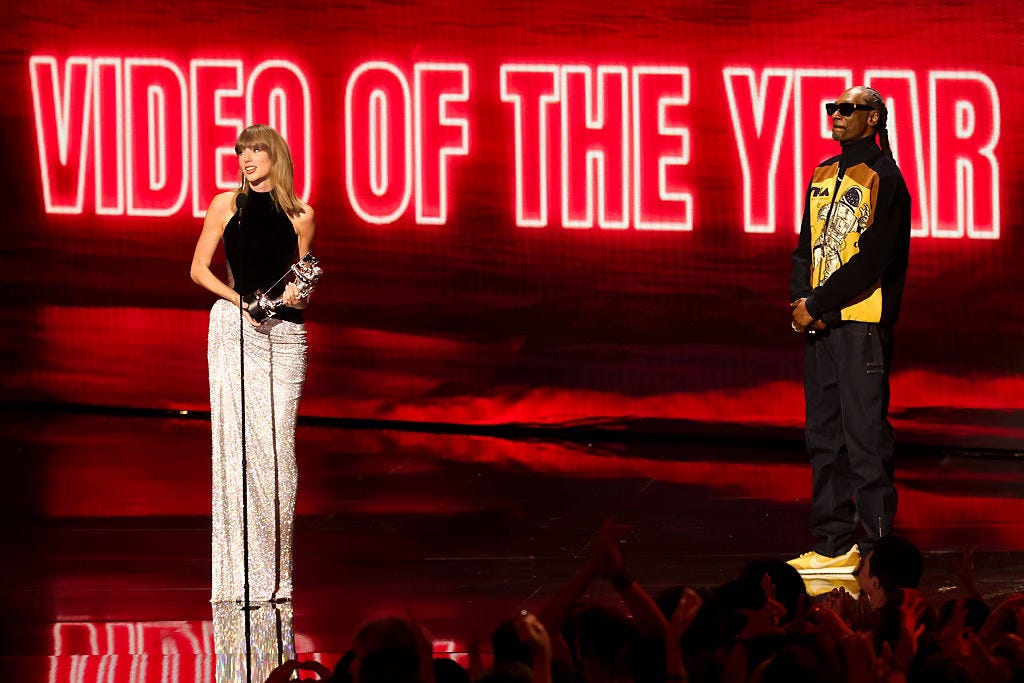
Looking Back at the VMAs: At this year’s Video Music Awards, Taylor Swift became the most-awarded artist in VMA history, surpassing Beyonce taking home multiple awards, including the newly created Artist Director award. She also premiered a new music video. The real center of the show was Madonna — or, in her words, “mother” — who gave multiple performances with star guests and took home several awards, including artist of the year. Apparently Mother has been resting up. This year’s show was heavy on nostalgia. Kacey Musgraves honored the late Dolly Parton with a cover of “I Will Always Love You.” Sombr and other artists paid tribute to George Michael. The surviving members of Nirvana accepted a lifetime achievement award. There were flashes of modernity, including well-received performances by K-pop star LISA, best new artist Sienna Spiro, and cloud rap icon Yung Lean. Not everyone was satisfied with the focus on the past — or the lack of messiness which some argue made the VMAs (in)famous. Paramount execs weren’t pleased either, it seems. Maybe the most nostalgic thing missing was the chaos. Let us know what you think in the comments.
News That Doesn’t Suck
Who Wants a T-R-E-A-T? Ever felt like your dog is listening to your conversations? Turns out they might be, to a degree we previously thought possible only among humans. Learning speech is tricky. To the uninitiated — say, a human baby — it’s little more than a string of unintelligible sounds. To identify individual words, babies look for patterns of consonants. That’s called “consonant bias,” and it happens because consonants tend to convey more information about the words being spoken than vowels. Until now, consonant bias had never been found in other species. Enter dogs, who’ve spent tens of thousands of years by our side. Researchers monitored brain activity in dogs as they listened to nonsense words. The vowel sounds were louder, so if the dogs were just noticing prominent sounds, they should have focused on the vowels. But they didn’t. Their brains zeroed in on consonants instead, a sign of consonant bias. So yes, they may actually be listening when you talk. This discovery adds to our understanding of how language evolves, and proves our furry friends really are paying attention to what we’re saying.
Want more information?
Please share this newsletter with family, friends, and anyone who wants to get the news and turn down the noise. If you’d like to sponsor our newsletter or our Instagram content, please reach out to us at community@newsnotnoise.com.
I read the Tompkins County AG's statement - thank you for linking to it. Several thoughts and questions come to mind. First, what I don't understand is why someone would report a sexual assault if their participation in sexual activity and drug use had been "voluntary, conscious, and consensual"? Sure, there's the idea that a person reports a rape because of "morning after regret"—especially perhaps if others hear about what took place. But her statement contains so much detail, including reporting what she did consent to. Was the AG's original reading of the law too narrow? I read that he "blamed Cornell University Police for doing an incomplete investigation, noting his office was not made aware of the text chat." In his statement he seems defensive and sure of his original decision, so I can't help but wonder if now that the story has become public he's the one suffering from "morning after regret."